By Michael Bonfiglio:
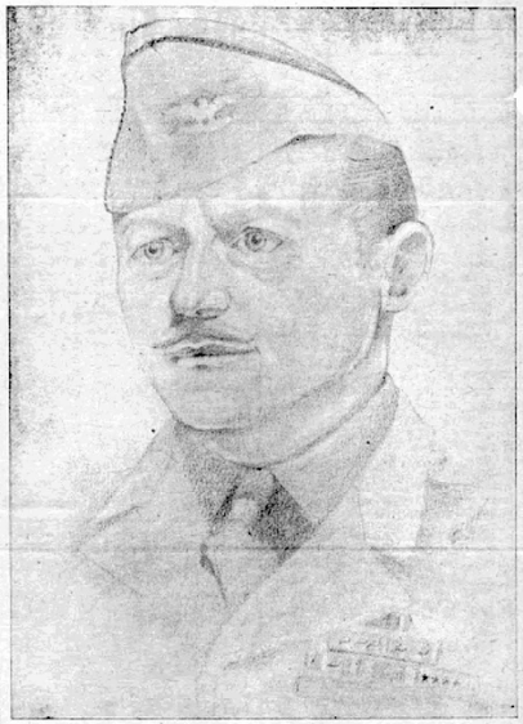
Image credit: ITEM Archive
Picture yourself as a regimental commander in the semi-arid highlands of Tunisia in 1943. You have just received word that a large-scale German offensive supported by tanks is advancing toward your position. Your radio barely works this far from friendly lines, many of your men are underequipped, and the artillery that was supposed to support you is withdrawing. What would you do to save the nearly 1,000 men under your command? Colonel Thomas D. Drake faced this nearly impossible situation during the fighting at the Battle of Kasserine Pass. His actions there became one of the defining episodes of his long military career.
Thomas D. Drake was born on October 24, 1900, in the small town of Tunnelton, West Virginia. When the United States entered World War I, Drake was eager to serve and lied about his age to enlist in the U.S. Army at only sixteen.[1] He served in France with the 4th Infantry Division and quickly established himself as a leader, earning the Distinguished Service Cross for his bravery and leadership in combat.[2]
Near Courchamps, France, friendly units on both sides of Drake’s platoon suffered heavy casualties and began to falter during an advance. Drake rallied the men and established a defensive position until relief arrived. Later, near Brieulles, he continued directing his troops after being wounded in the hand. Rather than leave the fighting to receive medical treatment, he remained with his men and repeatedly exposed himself to enemy fire. These actions established leadership qualities that would define the rest of Drake’s career, particularly his refusal to abandon his responsibilities under pressure.[3]
By the end of World War I, Drake had achieved the rank of sergeant and decided to continue his military career. During the years before World War II, he was stationed in the Philippines and China. He also received a commission as an officer and advanced through the ranks, eventually becoming a colonel shortly before the United States entered World War II.[4]
During World War II, Colonel Drake was given command of the 168th Infantry Regiment, part of the 34th Infantry Division.[5] He led the regiment following Operation Torch, the Allied invasion of French North Africa. Facing the battle-hardened, German Afrika Korps, the U.S. Army suffered serious casualties during its first months of combat in the theater. Drake and his men were no exception.
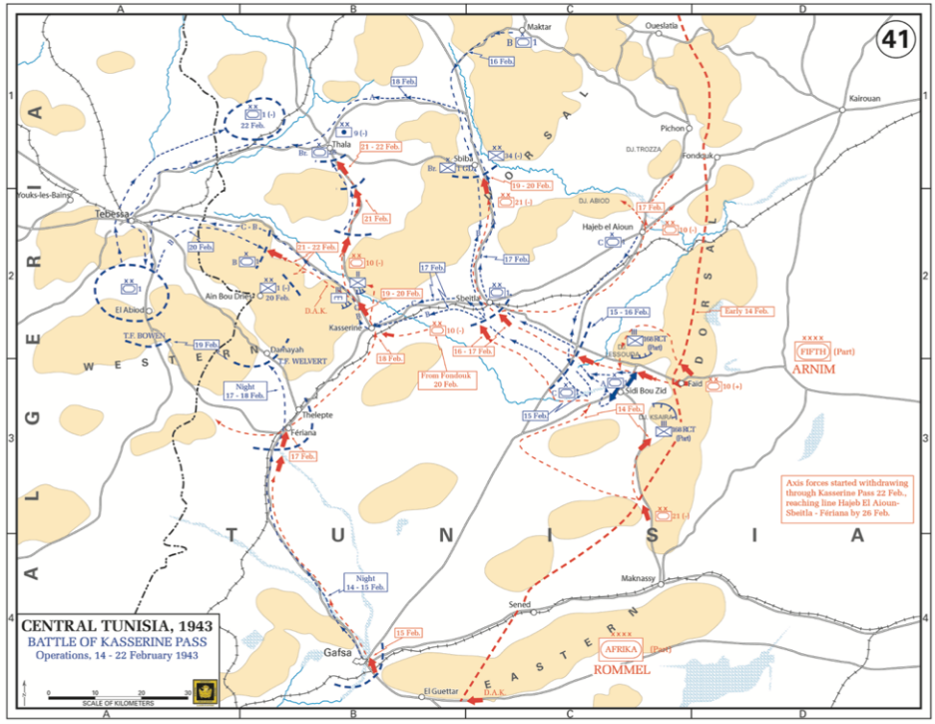
Image credit: Atlases – Digital History Center
In February 1943, Drake and his regiment were assigned to defend an area near Kasserine Pass. The regiment received approximately 450 replacements just before the German offensive began, but many were medical personnel, artillerymen, and tank-destroyer crews rather than trained infantrymen. This shortage of specialized infantry replacements was only the beginning of the problems Drake and the 168th Infantry would face.[6]
The greatest test of Drake’s career began on February 14, when German forces launched their offensive. The attack came quickly, and the 2nd Battalion was the first part of Drake’s regiment to face the German advance. Knowing that his regiment could not withstand such a large offensive alone, Drake made repeated attempts to request reinforcements, artillery support, and air strikes, but his requests went unanswered.
As a last resort, Drake ordered Major Marvin E. Williams to carry a message to the rear requesting assistance. Williams reached friendly lines and delivered the message, but Drake still did not receive the support he needed.[7] To make matters worse, the 17th Field Artillery supporting the 168th informed Drake that it had to withdraw because of the speed of the German advance.[8]
Realizing that his regiment was becoming isolated from friendly forces, Drake ordered his men to move onto the high ground of Djebel Garet el Hadid. Of the approximately 950 men dug in on the high ground with Colonel Drake, 300 were unarmed.[9] Surrounded by German forces, Drake and his men held their position for two days. The 1st Armored Division made several attempts to relieve them but was unable to break through the German lines.[10]
By February 16, the defenders had nearly exhausted their food, water, and ammunition. Drake eventually contacted General Orlando Ward and received an unclear message that left the decision of whether to hold, withdraw, or surrender to him. Ward also promised to have supplies dropped to the regiment, but they never arrived. With food, water, and ammunition nearly gone and no relief in sight, Drake decided to withdraw in an attempt to save what remained of his regiment.[11]
On the night of February 16, Drake and his men began the long march toward the designated rendezvous point at the town of Sbeitla. Marching through the night, the men of the 168th Infantry covered nearly twenty-five miles before daybreak. When Drake realized that they would not reach Sbeitla, he redirected the column toward the nearby garrison at El Hamir.[12]
As dawn broke the following morning, it became clear that the Germans had moved faster and caught up with Drake and his exhausted men. Surrounded once again, Drake reportedly rejected two demands to surrender before German forces separated him from his men and took him prisoner.[13]
The fighting near Kasserine Pass was a devastating loss for the 34th Infantry Division and a sobering defeat for the U.S. Army. The 2nd and 3rd Battalions of the 168th Infantry were effectively shattered. By the end of the battle, the 2nd Battalion had lost approximately half its strength, while only three men from the 3rd Battalion returned to American lines.[14]
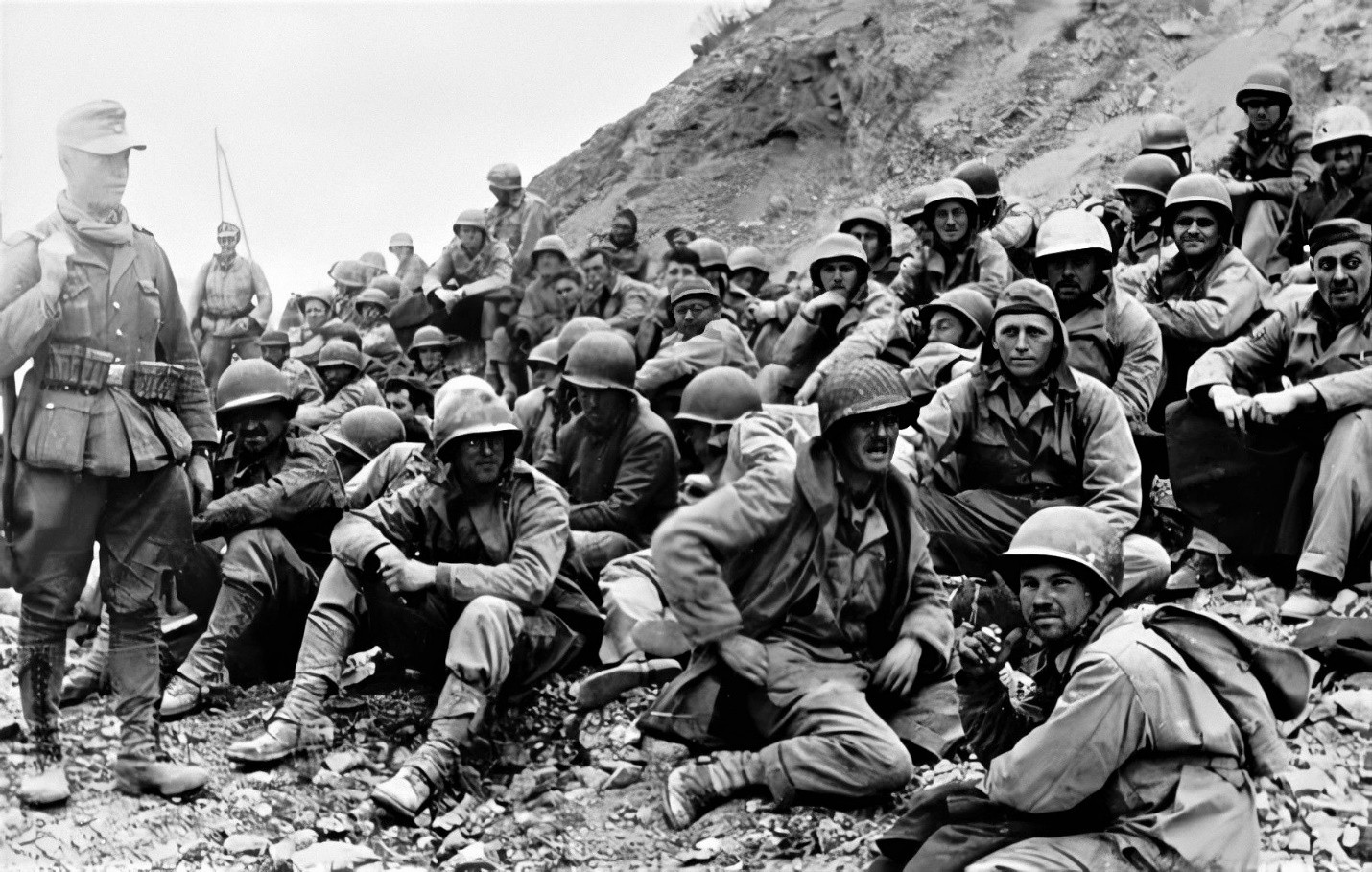
Image credit: 168th Regiment and 1st Armored Division G.I. pow’s after t… | Flickr
After a series of transfers, Colonel Drake eventually arrived at Oflag 64, a newly established prisoner-of-war camp in occupied Poland. As the senior American officer in the camp, Drake quickly established a military command structure and assigned responsibilities to fellow prisoners, like the organizational system used by the U.S. Army.[15]
More importantly, he established a working relationship with the German commandant, Oberst Schneider. His first meeting with the German commandant of Oflag 64 ended very abruptly and set the tone for their relationship early. Schneider reportedly addressed Drake in an angry or commanding tone. Rather than continue the meeting, Drake turned and began to leave without uttering a word. When Schneider asked what he was doing, Drake explained that he expected to be treated according to his rank and would return when the commandant was prepared to speak with him appropriately.[16]
Drake and Schneider eventually came to the agreement that Drake and the Americans should be responsible for the internal organization of the camp, while Schneider and the Germans remained responsible for its external administration. This arrangement allowed the American prisoners to maintain a degree of control over their daily lives despite their captivity.[17]
Drake’s authority over internal issues at Oflag 64 could be seen even in relatively minor disputes. After an American prisoner complained that dogs were being allowed into the barracks and creating unsanitary conditions, Drake raised the issue with the commandant. The problem was resolved, and dogs were no longer permitted inside the prisoners’ quarters.[18]
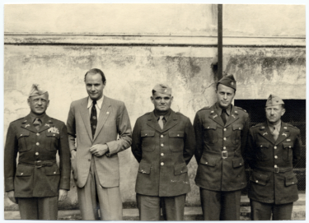
Image credit: Wartime Kriegy Photos
Drake also attempted to impose order on the prisoners’ uncertain existence. He encouraged the men to maintain military discipline and remain physically and mentally active. Over time, the prisoners organized a band, glee club, theater, medical facilities, camp store, and newspaper. These activities provided them with a degree of structure and normalcy despite their confinement. Digitally archived issues of the original camp newspaper, along with its modern successor, remain available through the Oflag 64 Association’s website.[19] [20]
Thomas D. Drake’s leadership was defined by his willingness to maintain command and accept responsibility when normal military structures had begun to break down. In France during World War I, he demonstrated personal courage and earned the Distinguished Service Cross. Then in World War II, he received a second Distinguished Service Cross for his actions in Tunisia, where he attempted to preserve the 168th Infantry despite inadequate supplies, unreliable communications, and the withdrawal of supporting units.[21]
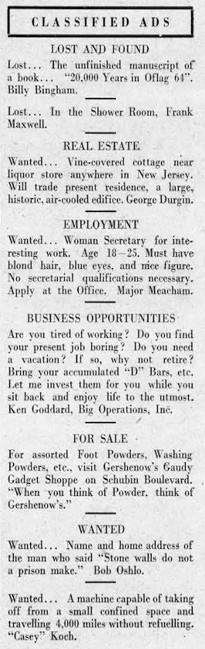
Image Credit: ITEM Archive
His capture required a different kind of leadership. Drake was no longer on a battlefield, but he could represent his fellow prisoners, confront German authorities, and maintain order within Oflag 64. The discipline he instilled was not simply about preserving military regulations. It gave the prisoners structure and a sense of purpose at a time when the future was uncertain, and they had little control over their own situation. Drake was repatriated in 1944 due to a serious illness. Records do not indicate what afflicted him, but he eventually recovered and spent the rest of the war as a technical advisor for Hollywood. His presence was surely missed by the prisoners left behind at Oflag 64.[22] Former prisoners remembered Drake as demanding and proud, but they also recognized the determination and confidence he brought to the camp.[23]
Drake could not save the 168th Infantry from defeat in Tunisia, nor could he free the men imprisoned with him at Oflag 64. Instead, his leadership can be seen in how he responded to circumstances largely out of his control. When support failed to arrive in Tunisia, he continued searching for a way to save his regiment. After becoming a prisoner himself, he continued accepting responsibility for the men around him. Whether fighting in no man’s land, commanding an isolated regiment in Tunisia, or representing American prisoners before a German commandant, Drake remained committed to his responsibilities as an officer and to the men who placed their faith in his command.
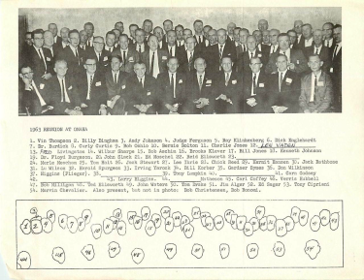
Thomas Drake is #50 sitting in the front row
Image Credit: Other Years Reunion Photos
[1] Ann C. Rogers and David Little. “Colonel Thomas Davisson Drake 1900 – 1970,” Oflag64Kriegy Research Group, Colonel Thomas D. Drake.pdf, p. 1.
[2] Doug Sterner. “Hall of Valor: Thomas Davisson Drake,” Hall of Valor by Military Times, accessed July 30, 2026, Thomas Drake – Hall of Valor: Medal of Honor, Silver Star, U.S. Military Awards
[3] Sterner, “Thomas Davisson Drake: Thomas Davisson Drake.”
[4] Rogers and Little. “Colonel Thomas Davisson Drake 1900 – 1970,” p. 1.
[5] Rogers and Little. “Colonel Thomas Davisson Drake 1900 – 1970,” p. 1.
[6] John H. Hougen, “History of the ‘Famous’ 34th Infantry Division.” 1949.
[7] John H. Hougen, “History of the ‘Famous’ 34th Infantry Division.” 1949.
[8] John H. Hougen, “History of the ‘Famous’ 34th Infantry Division.” 1949.
[9] John H. Hougen, “History of the ‘Famous’ 34th Infantry Division.” 1949.
[10] John H. Hougen, “History of the ‘Famous’ 34th Infantry Division.” 1949.
[11] John H. Hougen, “History of the ‘Famous’ 34th Infantry Division.” 1949.
[12] John H. Hougen, “History of the ‘Famous’ 34th Infantry Division.” 1949.
[13] Rogers and Little. “Colonel Thomas Davisson Drake 1900 – 1970,” p. 3.
[14] John H. Hougen, “History of the ‘Famous’ 34th Infantry Division.” 1949.
[15] Rogers and Little. “Colonel Thomas Davisson Drake 1900 – 1970,” p. 6.
[16] Rogers and Little. “Colonel Thomas Davisson Drake 1900 – 1970,” p. 6.
[17] Rogers and Little. “Colonel Thomas Davisson Drake 1900 – 1970,” p. 6.
[18] Robert Galloway, dir. “Oflag 64: A P.O.W. Odyssey,” Galloway Productions LLC, 2001. Oflag 64, A POW Odyssey
[19] Robert Galloway, dir. “Oflag 64: A P.O.W. Odyssey,” Galloway Productions LLC, 2001.
[20] https://www.oflag64.us/item.html
[21] Sterner. “Thomas Davisson Drake,” Hall of Valor by Military Times, accessed July 30, 2026.
[22] Rogers and Little. “Colonel Thomas Davisson Drake 1900 – 1970,” p. 7.
[23] Robert Galloway, dir. “Oflag 64: A P.O.W. Odyssey,” Galloway Productions LLC, 2001.
Caldwell, Caldwell, Kelly, and Weatherford. “Oflag 64 Remembered: Honoring our Kriegy Patriots and Heroes.” Oflag 64 Remembered, Oflag 64 Remembered.
Galloway Robert, dir. “Oflag 64: A P.O.W. Odyssey,” Galloway Productions LLC, 2001. Oflag 64, A POW Odyssey.
Hougen, John H. “History of the ‘Famous’ 34th Infantry Division.” 1949.
Lewis, Charles. ”Find a Grave: Col Thomas Davisson Drake,” Find a Grave, April 16, 2017, COL Thomas Davisson Drake (1900-1970) – Find a Grave Memorial.
Rogers, Ann C., and Little, David. “Colonel Thomas Davisson Drake 1900 – 1970,” Oflag64Kriegy Research Group, Colonel Thomas D. Drake.pdf.
Sterner, Doug. “Hall of Valor: Thomas Davisson Drake,” Hall of Valor by Military Times, accessed July 30, 2026, Thomas Drake – Hall of Valor: Medal of Honor, Silver Star, U.S. Military Awards
U.S. Army Center of Military History. “Kasserine Pass Battles: Readings.” Vol. 1, pt. 1. U.S. Army Center of Military History, 1992.