“…we gave them a very good drubbing…”
Cook’s Battalion of Connecticut Militia at the First Battle of Saratoga (Battle of Freeman’s Farm),
September 19, 1777
CPT (CT) Matthew E. Reardon, Command Historian, Connecticut Military Department
On the morning of September 19, 1777, Sergeant Eleazar Gaylord awoke in his tent just south of the John Neilson House along Bemus Heights near the village of Saratoga, New York. He had been with the Northern Army for about nine days. The 24-year-old native of Windsor, Connecticut, was attached to Captain Jonathan Wadsworth’s Company in Cook’s Battalion of Connecticut Militia. Gaylord was one of almost four hundred militiamen who served in the battalion which, upon its arrival, was reviewed by the army commander, “who remarked they [we] were fine Looking men.” [1]
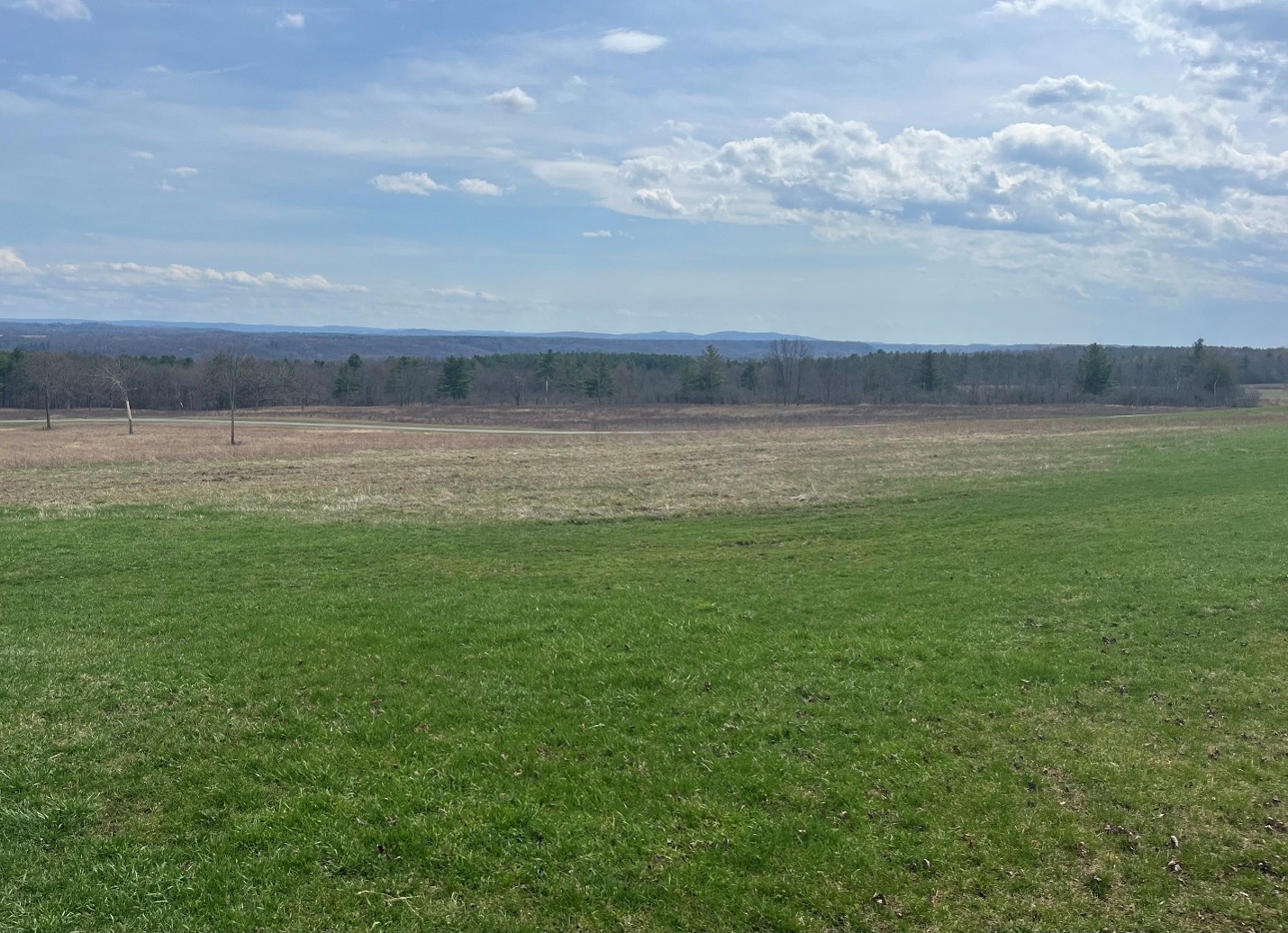
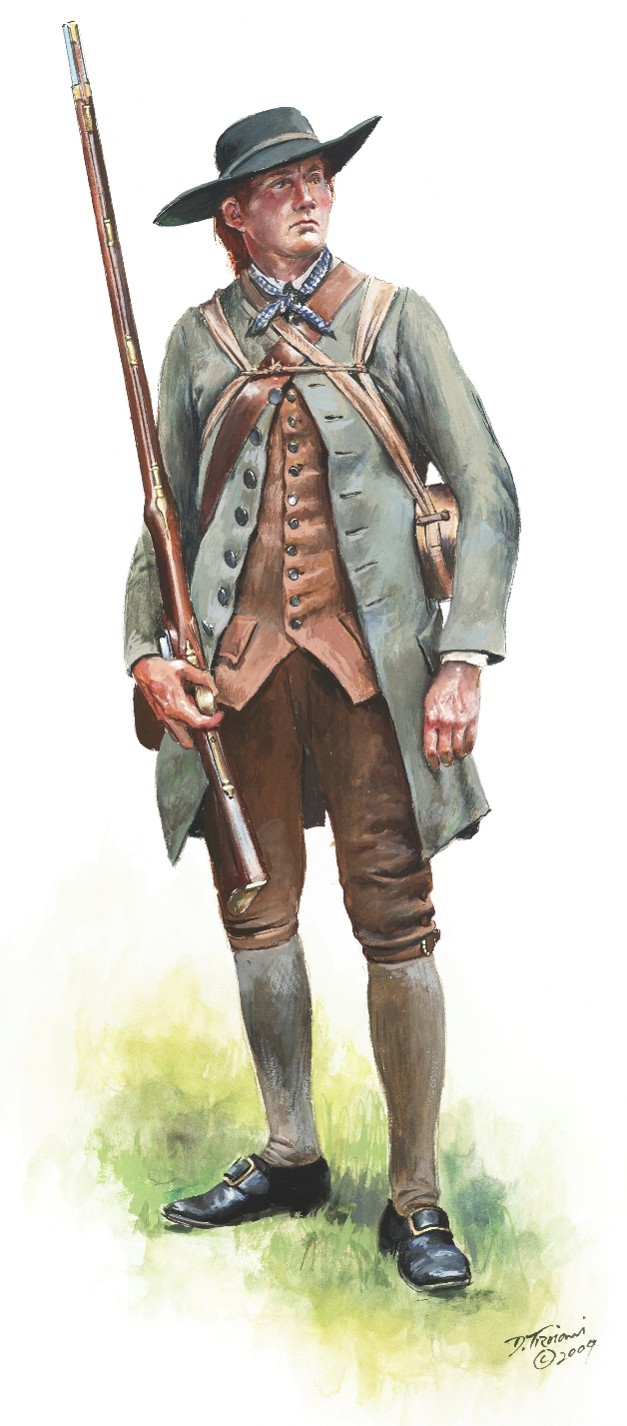
Cook’s Battalion was raised the previous month by order of the General Assembly, the state’s legislative body, to assist the Continental Northern Army, which was attempting to repel a British invasion from Canada under Lieutenant General John Burgoyne, who was advancing on Albany. Named for its commander,
Colonel Thaddeus Cook, the battalion consisted of eight militia companies hastily drawn from Hartford, Litchfield, New Haven, and New London counties. Today, the 1st Battalion, 102nd Infantry Regiment, Connecticut Army National Guard, carries on its lineage.
Since September 12, the Northern Army led by Major General Horatio Gates had been positioned on Bemus Heights, an imposing ridgeline blocking the road south to Albany, some thirty miles away. On September 19, seeking to dislodge the Northern Army from this formidable position, Burgoyne launched a three-pronged advance on Bemus Heights. By noon, American scouts had detected British troops moving toward their position, prompting a swift reaction. Colonel Daniel Morgan’s Corps of Riflemen and Light Infantry were then dispatched to “observe their Direction and harass their advance.”2
Around 1:00 p.m., advance parties clashed on John Freeman’s Farm, firing the battle’s opening shots. As the engagement escalated, the 1st New Hampshire Regiment – followed closely by the 3rd New Hampshire Regiment – were sent forward to reinforce Morgan. Cook’s Battalion remained in reserve, awaiting orders. At about 3:00 p.m., their moment arrived. Drums sounded the “Beat to Arms,” bringing Cook’s Battalion to its feet as company commanders quickly formed their men into column formation.3
Before the march, according to Philo Woodruff of Captain Tarbell Whitney’s Company, they were visited by their division commander, Major General Benedict Arnold. Woodruff recalled that “Gen’l Arnold addressed us,” though his likely encouraging remarks were not recorded. Cook’s Battalion was then “led on to battle,” marching toward Freeman’s Farm to reinforce the American forces already engaged there.4
As they marched north along Quaker Springs Road, the sounds of battle grew steadily closer, heightening the men’s anxiety. Their unease deepened as wounded soldiers passed them on their way back to Bemus Heights. Sergeant Gaylord described the experience to his son, who recalled his father’s words: “I have heard [him] tell his feelings as he was advancing into the action: That they met wounded & dying men, being brought from the field, [where] he was entering. That he felt far worse than when he was in the hottest of the fight.”5
Cook’s Battalion reached Freeman’s Farm about 3:30 p.m., where they fell under the command of Colonel Alexander Scammell, of the 3rd New Hampshire Regiment. Scammell deployed it on the right, or southern end of his battle line. Facing east toward the Freeman house and barn, the American line consisted, from north to south, of the 3rd New Hampshire Regiment, the 1st New Hampshire Regiment, and Cook’s Battalion.6
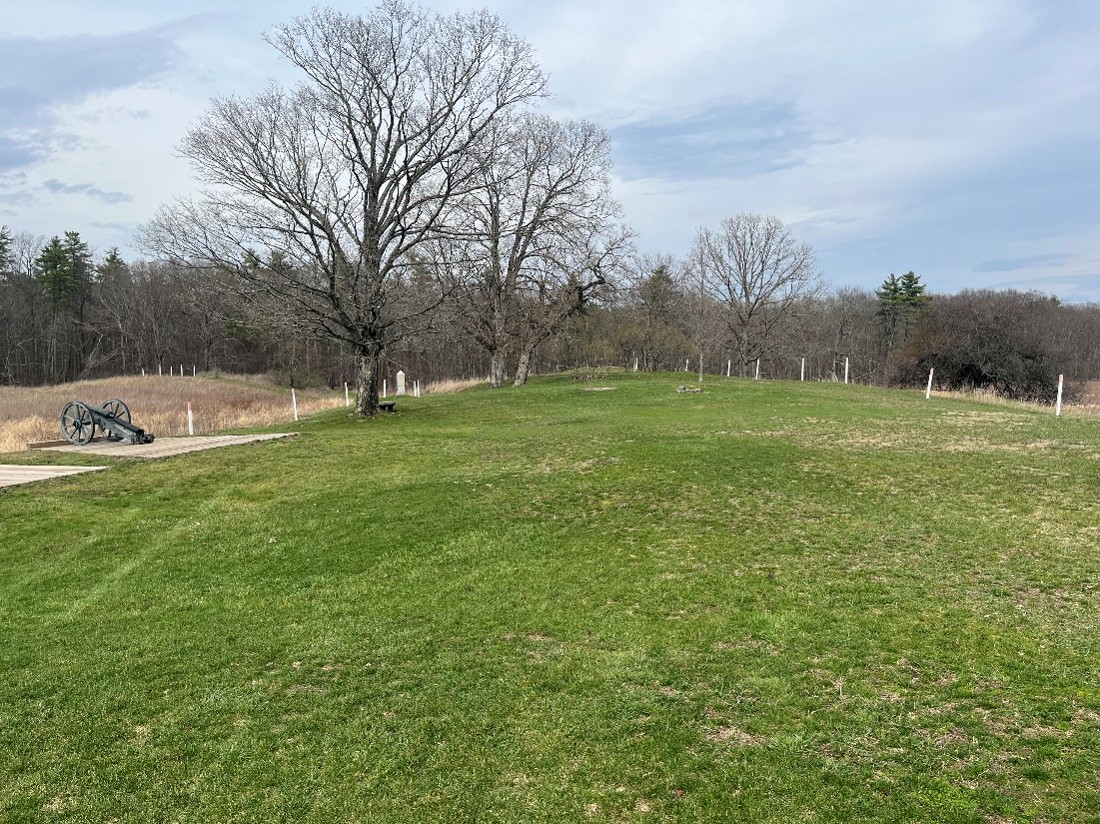
The British soon attacked their position. North of the Freeman House stood the 21st (Royal North British Fusiliers) Regiment of Foot with two 6-pounder field pieces, while the 62nd Regiment of Foot occupied ground south of the house near a log outbuilding with two additional 6-pounders. The British artillery opened fire into the woods, in what Scammell described as “the hottest Fire of Canon…[he] heard in [his] Life.”7
Solid and case shot soon exploded above the heads of Cook’s Battalion, sending down shards of tree limbs and branches onto the militia. One American officer reported, “not a shot from their field pieces took effect, except among the limbs of trees.” Sergeant Gaylord similarly recalled that the British cannon “did not seem to take aim at any object… & fired almost continuously over [our] heads.”8
As the cannon roared, the British regiments advanced in open order towards the American line, resorting to “the national weapon”—the bayonet—to drive the enemy from the field. As the redcoats pressed forward, Cook’s Battalion “fled…deeper still into the woods,” along with the 1st New Hampshire Regiment, deliberately drawing the 62nd Foot after them. As the 62nd entered the woods, the men advanced from tree to tree, trading shots with the concealed Americans. Consequently, those [in the regiment] “who had been the most forward in the pursuit were the first to fall.” By pushing so deep into the timber, they became dangerously overextended, allowing the American forces—who now heavily outnumbered them—to envelop the vulnerable redcoats. Sustaining heavy casualties, the 62nd Foot was soon broken and forced to retreat.9
The 62nd Foot withdrew to their original position near the log outbuilding. As they did, the soldiers of Cook’s Battalion followed them, intending to pursue their fleeing enemy. While the redcoats were attempting to reform their battered ranks, some took shelter inside the log structure. Sergeant Gaylord frequently recalled the structure in later years. He told his son, “There was a [log] house between the two lines, filled with the enemy; that he fired into [it] a number of times.” On another occasion, he added that “several times a soldier of the enemy would appear at one of its [doors] to fire upon them,” and that he “sharply watched the movement & [whenever] such object appeared [they] fired upon and in repeated instances after such discharge a man fell but [whose] ball it was that hit him he would not pretend to say.” At one point, members of Cook’s Battalion even attempted to seize the structure. Private Luther Savage of Captain Joseph Blague’s Company testified that he “was one of eight that ran between the firing of the Americans and their enemies, to a log house, a gun shot from our troops, comparatively in the jaws of the enemy, and took sixteen prisoners, one of them, [an officer] in the British Army.”10
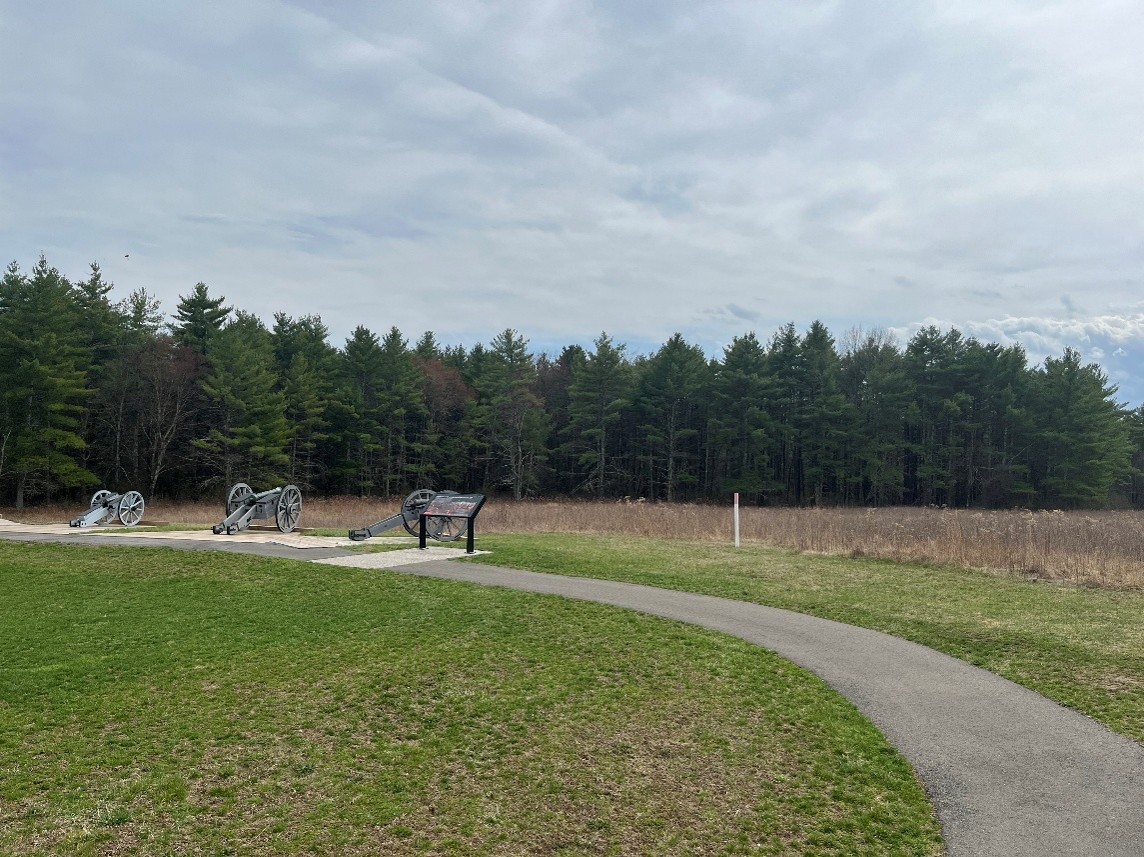
The 62nd Foot eventually reformed their ranks and launched another attack against Cook’s Battalion. Pushing too far, they once more overextended themselves and, after taking heavy casualties, were forced to retreat out of the woods. This deadly “back and forth game” would be repeated some three or four times.
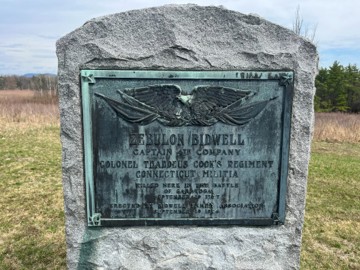
After almost two hours of fighting, Cook’s Battalion was exhausted. Casualties had been mounting steadily, particularly among its officers. Captain Zebulon Bidwell was “mortally wounded by a cannon ball which destroyed one of his legs.” Captain Wadsworth was “shot in the bowels.” His actions were singled out, stating that “[Wadsworth] in particular has done himself eternal honor.” Both officers were carried from the field and later died of their wounds.11
The battalion was also running low on ammunition. Scammell recognized the situation and, when a detachment from Learned’s Brigade under Major William Hull arrived to reinforce his position, Scammell sent Hull “to march to [Cook’s] support.” Cook’s Battalion was then withdrawn to Bemus Heights, though they had paid dearly for their stand. They sustained casualties totaling 53 men: 11 killed, 39 wounded, and 3 missing—the second highest total among the eleven different American units engaged at Freeman’s Farm.12
Cook’s Battalion had “behaved bravely,” and, in the words of Sergeant Eleazer Pinney of Captain Bidwell’s Company, gave the British “a very good drubbing.” That “drubbing” helped halt Burgoyne’s advance toward Albany, contributing to the surrender of Burgoyne’s army four weeks later.13
[1] Eleazar Gaylord Pension Application, (W.17941), National Archives and Records Administration (hereafter NARA); Abner Holcomb Pension Application (S.13433), NARA; Orderly Book of Capt. Thaddeus Cook of Wallingford Connecticut, American Antiquarian Society.
[2] Horatio Gates to John Hancock, September 22, 1777, Horatio Gates Papers, New York Historical Society.
[3] Abner Holcomb Pension Application, (S.13433), NARA; Josiah Sheldon in Caleb Sheldon Pension Application, (S.19087), NARA.
[4] Philo Woodruff Pension Application, (S.15720), NARA.
[5] Eleazar Gaylord Pension Application, (W.17941), NARA.
[6] Alexander Scammell to Jonathan Chadbourn, September 26, 1777, William L. Clement Library, University of Michigan.
[7] Colonel Alexander Scammell to Dr. Samuel Leslie Scammell, September 21, 1777, Rosenbach Museum & Library.
[8] Eleazar Gaylord Pension Application, (W.17941), NARA; Unidentified American officer, September 20, 1777, Saratoga National Historical Park. Artillery fire was ineffective against troops in woods; this served more for psychological effect than inflicting casualties.
[9] John Money, A Letter to the Right Honorable William Windham, on the Partial Re-Organization of the British Army. (London: T. Egerton and Carpenter, 1799), 16-17.
[10] Eleazar Gaylord Pension Application, (W.17941), NARA; Luther Savage Pension Application, (R.9225), NARA.
[11] Elisha Bidwell Pension Application, (S.12221), NARA; Eleazar Gaylord Pension Application, (W.17941); Thomas Seymour Jr. to Thomas Seymour Sr., September 20, 1777, Governor Jonathan Trumbull Papers, VII:57a-b, Connecticut State Library.
[12] “A Return of the Killed, Wounded & Missing of the Division under the Command of Major Genl Arnold between Stillwater & Saratoga Septr 19th, 1777,” Thomas Addis Emmet Collection, New York Public Library; Revolutionary Services and Civil Life of General William Hull; Prepared From His Manuscripts, By His Daughter Mrs. Maria Campell, Together with the History of the Campaign of 1812 and Surrender of the Post of Detroit, by his Grandson, James Freeman Clarke. ed. Maria Campbell (New York: D. Appleton & Co., 1848), 94.
[13] Thomas Seymour Jr. to Thomas Seymour Sr., September 20, 1777, Governor Jonathan Trumbull Papers, VII:57a-b, Connecticut State Library. Eleazar Pinney in Zenas Skinner Pension Application, (S. 14468), NARA.

